Cost per Tuesday
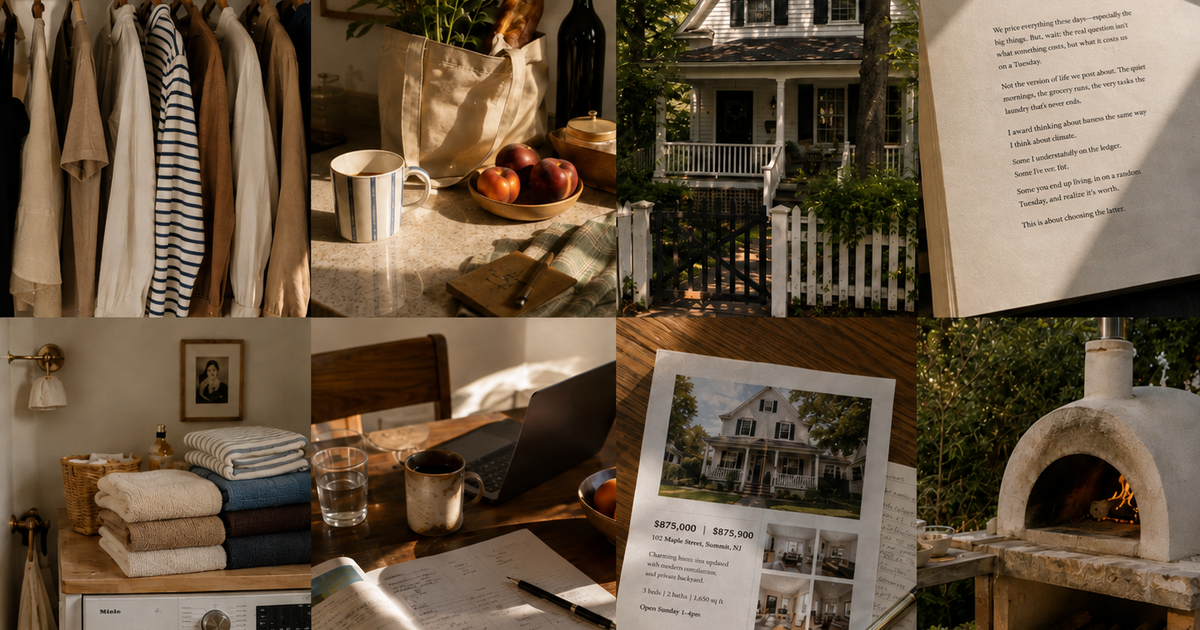
Nobody goes shopping anymore. Shopping comes to us. A shirt appears on your feed, worn by someone living the life the algorithm knows you want, and one tap later you've got twenty tabs open and both sizes in the cart. New clothes, new me. When shopping for clothes, we often buy things for the person we are becoming, not the person who’s doing the laundry.
That’s how you end up with a closet split in two: the thing from your FYP you NEEDED and have worn exactly once, and the basics you’ll wear to death. And you learn, slowly and expensively, which purchases were for the style you thought you wanted, and which are for the person you actually are.
Now open Zillow. You’re hearting houses with updated kitchens, your friends are sending you listings and saying, “Wait, I saw this and felt like you might really like it.” They’re not sending you a house. They’re sending you what they think a version of your future self would like. When we are on our phones at 11 PM, we are not evaluating shelter options. We are lying in bed, retainers in, matching PJ set on, trying on houses… and wondering why, when we go see them in person, we feel disappointed.
This clothes comparison isn’t just a metaphor. It’s an operating system, and fashion figured out the theory before housing could admit it’s doing the same. The stakes could not be more different, but somehow the shopping experience is almost exactly the same.
The loudest garment
Start with the obvious layer. Money talks. Clothes talk. Houses talk. In 1899, economist Thorstein Veblen coined “conspicuous consumption” for purchases made less about the use and more about what owning them announces. Fashion people know this instinctively; it’s the reason why some of the ugliest purses cost more than a year of college. But a house is the loudest garment you will ever wear… the biggest, the most visible, the one you can’t take off at the door. The chef’s kitchen in a household that orders out five nights a week is doing precisely what the unscuffed designer sneakers do: communicating capacity. We could host twelve. The hosting is optional. The announcement is the product.
The second layer: newness has a half-life.
Psychologists call this hedonic adaptation, which is a fancy way of saying that the high of anything new eventually fades into something you barely notice, even though a small part of you always insists… “This time will be different.” Just as every relationship has the honeymoon phase, every purchase has one too. Our closets are proof. The new dress you bought becomes, after about three wears, just another dress.
This is the uncomfortable thing we don’t talk about: your new kitchen works the same way. The finishes and the wallpaper and the little details you chose and really notice… the excitement may last longer than it did for the dress you just bought… but what survives adaptation in a house is the same thing that survives in a wardrobe. Not the statement pieces. The elevated basics. The light, the flow, the commute, the way things work on a Tuesday, not when you’re hosting.
The best house might not be the one that impresses you most at first. It might just be the one that makes your actual life less annoying… and the outdoor pizza oven is a perfect example. A listing can really sell you on the pizza oven sitting beside the backyard grill. But how often are you actually going to say, “I’m hungry. I’m going to stand outside and make a pizza”? Living five minutes from the grocery store, though? That never gets old. In fact, the boring conveniences are often the ones you use every single day.
Fashion theory’s most useful innovation is cost per wear. I’d argue a house has its own version: Cost per Tuesday. What you paid per ordinary day actually lived in it, not per party hosted.
Trying On a life
“People are shallow, houses are clothes… gotcha.” That’s not correct, and people in fashion know exactly why. Nobody who loves clothes thinks clothes are trivial. Your fit changes because you change. Dressing is identity. You go through so many phases in life before you find the style that fits. Oh, and it’s not just the style that fits your lifestyle, but the style that fits your body. The catch is that clothes are a bit less expensive than real estate in Los Angeles.
The point is not to buy the boring house. It is to understand which parts of the fantasy will still matter after the fantasy becomes your routine.
And I’m definitely not saying it’s bad to browse every house online, zoom into every photo, and check every feature from your couch. That access is a gift. What gets me is something different: the approach we use for an $80 sweater is, click for click, the same approach we use for a $3 million house. Same tabs. Same filters. Same saved-for-later. Same “let me send this to the group chat.” The lookbook, the size filter, the cart… the whole apparatus is identical, and something about that should feel a little funky to you.
The only real difference? With the sweater, you can order both sizes and return the one that doesn’t fit. With the house, there’s no ordering two and keeping the better one. No free returns. The one purchase where you can’t try before you commit is the one we shop for exactly like the ones where you can.
The problem is not that we shop for houses online. It’s that everything moved to a website, where a photographer is paid to shoot the best angles, and the real house eventually has to compete with the version of itself we met first.
Buy for the Tuesday
So where am I going with this? Buy the house… like people with great closets buy clothes. Know your cost per Tuesday. Be suspicious of anything at trend peak. Pay attention to what fits your actual life, not just what photographs well enough to represent the life you hope to have.
Picture an average Tuesday afternoon. You’re carrying groceries inside. Someone is doing homework at the kitchen table. The dog needs to go out. You’re tired. Nobody is hosting, and nobody is admiring the backsplash.
Does the house make that day easier? Does it give everyone enough room without separating them? Does it work when your life is ordinary and slightly messy?
Eventually, even your dream house becomes simply the place you live. That does not mean you chose wrong. It means it became your home.
You are not only buying for the person scrolling Zillow at 11 PM. You are buying for the person who wakes up there on Tuesday morning and does the laundry… and that person probably cares a lot less about the backyard pizza oven than the listing description convinced them they would.
Thanks for reading Overthinking Real Estate! Subscribe for free to overthink why we buy, sell and make decisions the way we do in real estate.