The Biggest Purchase of Your Life Runs on Reply-All
Why real-estate transactions still rely on fragmented email, document copies, and weak information architecture.
A note before we start: I try to keep these essays shorter. This one runs long because it sits at the intersection of two industries, and the more I looked at how a real estate transaction actually works, the harder it became to understand why some of the most important parts of it still run the way they do.
And the important part: this is a personal essay, not legal, cybersecurity, compliance, or professional advice. The views are mine alone and do not represent any current or former employer, brokerage, client, or other organization. This is simply one girl who happens to work in both real estate and cyber risk, writing about what she has noticed.
Read the whole thing. Worst case, you lose twelve minutes. Best case, we fix real estate together.
Let me show you a week from one of my actual deals, lightly anonymized:
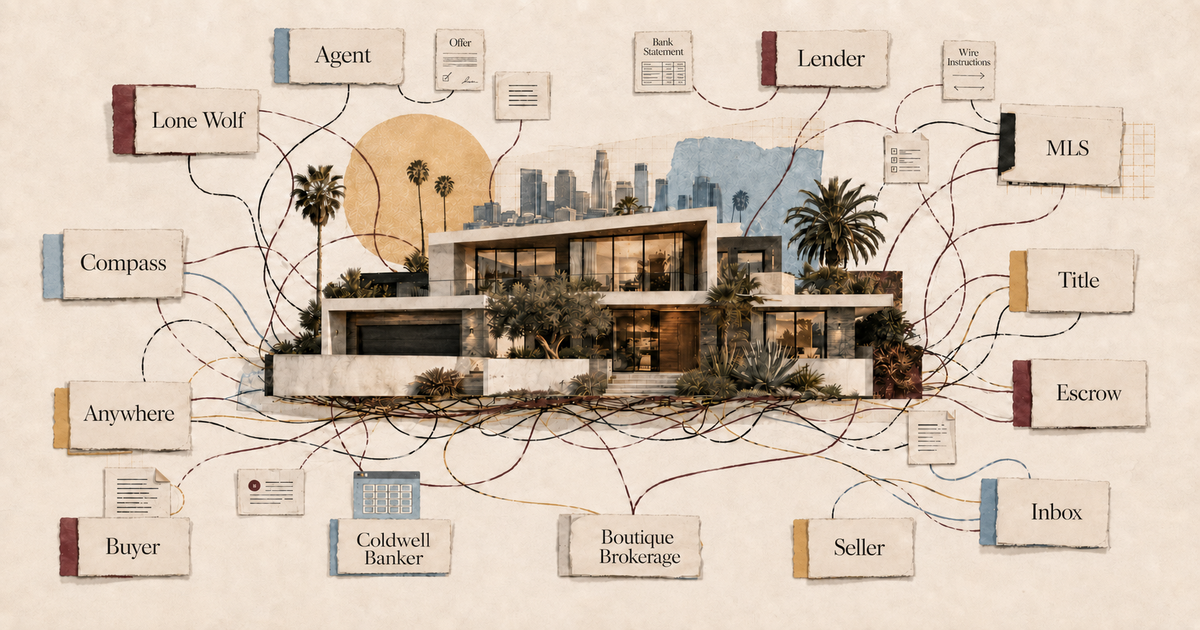
Eleven people cc’d across six companies. Two brokerages, a lender, an escrow office, a transaction coordinator for both sides. Someone asks the thread to “please forward the buyer signed disclosures ASAP, apologies if you did and I missed it!” The loan officer replies, “are you speaking about the attached fully executed amendment?” which was a fair question, because by then there were three amendments and nobody was entirely sure which one governed.
At one point, the disclosures arrived as a wall of acronyms… TDS, SPQ, LPD, BCA, SIR, ABA, SBSA…. attached to an email… forwarded to another email…. signed through DocuSign, or maybe Authentisign, depending on whose forms we were in that day…. and then forwarded back.
Nobody on that thread was bad at their job. Everyone was responsive. Everyone was trying. But notice what a lot of the work actually was: figuring out what was true.
Which version is signed? Which is the now agreed upon price? Which document is still outstanding? Which attachment is the one we are actually working from?
Software people have a name for the place where the current state of something lives: the system of record.
In many transactions, a seven-figure home sale doesn’t really have one… and that is what this essay is about.
Let’s start with a question that keeps me up at night because nobody, including me, can answer it: who, at this point, has copies of the buyers’ bank statements? Copies were downloaded, forwarded, saved… and nobody can tell you where they all live now. Once something leaves as an email attachment, you lose a meaningful amount of control over what happens next.
Was this an unusually messy deal? Not really. This is just how the industry works.
and shocker… I hate it.
And because one year in one city is a small sample, I checked. I asked agents in Chicago, New York, and Northern California how their process works. Every single one of us is emailing. Across the agents I spoke with, the $200,000 house in the middle of nowhere and the $50 million Beverly Hills listing still relied heavily on the same infrastructure: an inbox.
The Facts
A few numbers, just for scale.
As of Inman’s April 2026 count, the U.S. still has nearly 500 separate Multiple Listing Services, after nearly half of the country’s MLSs disappeared through consolidation since 2015 (Inman mapped them)
On top of that, the average brokerage uses more than 20 different software tools, per T3 Sixty.
There are plenty of tools in a real estate transaction. The problem is that most of them belong to one company or one side of the deal.
Your brokerage has its systems (SkySlope, maybe, or dotloop). The other brokerage has theirs. The team runs its leads through Follow Up Boss. The lender has a portal. Escrow has software, like Qualia. Documents might be signed through another platform entirely. And then those systems have to talk to each other.
That is usually where email comes back in.
Email is also part of the environment where the money gets stolen. The FBI's IC3 reported more than $275 million in losses from real-estate-related fraud in 2025, up nearly 60% from over $173 million the year before (NAR, citing FBI IC3). $275 million looks small next to a trillion-dollar market… until you remember what it actually is. Down payments and life savings of everyday people. And that's only what got reported to the FBI.
Your offer, your bank statements, your ID, your wire instructions… some of the most sensitive paperwork most people will ever generate… still routinely move as attachments.
Meanwhile, the industry is investing heavily in AI. Compass's merger with Anywhere closed in January, and Compass has been rolling out its "AI-driven" Home Platform across company-owned brands including @properties, Coldwell Banker Realty, Corcoran, and Sotheby's International Realty (Real Estate News). Lone Wolf is rolling out AI of its own, starting with BrokerMetrics. So is every CRM with a keynote slot.
Let me be clear about something before I go further: I am not anti-AI. The opposite actually. I use AI constantly… at my day job, in my real estate work, in writing this newsletter. I think it’s the most useful tool I’ve picked up in years. Which is exactly why the industry’s version of it makes me a little crazy.
AI is only as good as the information you point it at. And real estate is pointing it at an inbox where nobody can say which amendment governs, which version is signed, or who has the bank statements. Announcing AI on top of that is like installing a smart-home system in a house with no locks on the doors. The technology isn’t the problem. The order of operations is.
My day job is in cybersecurity and third-party risk management (how I ended up doing that and selling houses at the same time is its own story), where you spend a lot of time thinking about what can go wrong when sensitive information moves through complicated processes. And to be fair to email for a second, the problem isn’t simply that “email is not secure.” Email can be encrypted in transit.
The problem is what happens after you hit send.
If a vendor came to me at work and said its process for moving six-figure wires involved eleven people at six companies, permanent copies scattered across inboxes, and no authoritative record of the current contract state, that assessment would be painful.
Real estate is that vendor.
The Theory
In 1937, a young economist named Ronald Coase asked a question that sounds almost too basic to be important: why do companies exist at all? If markets work so well, why doesn’t everyone freelance? Why not buy every task and service separately whenever you need it? and his answer, in a paper called The Nature of the Firm, was that using the market itself has costs.
You have to find people. Negotiate. Exchange information. Supervise. Coordinate. Keep everyone working from the same facts. When those coordination costs get high enough, sometimes it is cheaper to bring the work inside one organization. One company. Shared systems. Some common authority. That is part of what a firm does: it makes coordination cheaper.
Real estate gets interesting because the firm stops surprisingly early.
A brokerage looks like a firm from the outside. One brand, one office, a compliance department. But even the brokerage itself is less centralized than it seems. Agents are independent contractors. Transaction coordinators often run their own separate businesses. Assistants are usually hired by the agent or the team, not the brokerage. Strip it down and the brokerage is really holding the license and the compliance file.
And most of the transaction does not even happen there. The lender works for another company. Escrow or title works for another. The inspector may have their own business. The other agent belongs to a completely different brokerage. The buyer and seller are outside all of them.
For thirty or sixty days, these people have to coordinate as though they are one organization… same dates, same contract terms, same understanding of what changed, same sense of who is waiting on whom. But they do not share a boss, and they do not share systems.
So we built the next best thing: the email thread.
Put it in Coase’s terms and the problem becomes pretty obvious. A transaction has many of the coordination needs of a company without actually being one.
It behaves like a temporary firm.
And because that temporary organization disappears in sixty days, every new transaction starts over: new people, new threads, new attachments, new attempts to reconstruct the same shared reality.
Reply-all becomes the deal room.
Ctrl-F becomes version control.
This is where Coase starts to make a lot more sense to me. The mess is not just the result of people being disorganized. It keeps happening because the transaction is split across companies that each own one piece… the MLS has one part, the brokerage another, title, escrow, lenders and software vendors the rest.
The agent may technically be responsible for the transaction as a whole, but so much of it depends on third parties that no one person can realistically control the entire thing.
Why Digital Doesn’t Mean Simple
Real estate did successfully digitize a lot of the transaction.
Paper became PDFs. Physical signatures became e-signatures. Forms got faster. Storage got better. Those were real improvements.
But digitizing documents is not the same thing as making a transaction easier to understand. We moved the filing cabinet onto the internet, and yet the overall experience can still be surprisingly difficult to follow.
This is also where my two jobs start to overlap in ways I didn’t expect.
Email shares information by copying it. I need you to see this, so I will send you a copy.
That model works beautifully for a dinner reservation or a birthday invitation, not for a proof of funds on a $4 million house.
Every time another person needs the information, another copy can exist. And once copies spread across companies, it becomes harder to answer both of these questions:
Which version is current?
Who still has it?
The weird part is that you can put sophisticated professionals, expensive software, and millions of dollars in one transaction and still end up hunting through email for the right attachment.
We have made many individual tasks faster, but that does not always make the overall experience feel clearer. This is because a deal can move forward while the people inside it are still spending time reconstructing what happened.
The same basic questions keep coming back: What is current? What changed? Who is waiting on whom?
Maybe that is why a deal can be fully digital and still feel weirdly manual.
Why I Keep Thinking About This
If I only worked in cybersecurity, I doubt I would ever think this much about real estate transactions… Why would I? From the outside, the inner workings of an industry are invisible.
And if I only worked in real estate, I probably would not think twice about emailing a bank statement. That is just how things are done.
It is a somewhat uncomfortable position to write from because I am only one year into real estate. I would never pretend to be an expert on the industry yet. Risk is different: I studied it in college, interned in technology risk at one Big Four firm, and have spent the last four years in third-party risk management at another. I am much closer to a subject-matter expert there.
But maybe that difference in experience is partly why this stood out to me. In one year of working in real estate, I have seen financial documents sent through email, multiple versions of agreements circulating at once, and sensitive information moving through processes that can be difficult to reconstruct after the fact. I am new enough to still notice the things the industry has learned to treat as normal, but experienced enough in risk to understand why they make me uncomfortable.
It took doing both jobs at once… writing vendor-risk assessments during the day and getting cc’d on transaction threads afterward, to realize I was participating in the exact kind of information environment I spend my other job evaluating.
The people who experience the workflow every day are used to it, and the people trained to question risk rarely have to live inside an escrow.
Why Better Software Hasn't Made This Simple
There are two companies I keep coming back to because they show two very different ways the industry has tried to make the work easier.
Lone Wolf Technologies built broadly across the industry. Forms, e-signatures, transaction management, brokerage back office, zipForm, Transactions, Authentisign, Back Office, the whole stack… By the company’s own count, it serves more than 1.5 million real estate professionals across the U.S., Canada, and Latin America, and zipForm is deeply embedded in how agents work (Lone Wolf, 2026). In California, it is practically the water we swim in.
That gives Lone Wolf reach.
But its products, like most transaction technology, still largely organize the world around a brokerage’s file. It can make your side much more coherent. Like most software, it is very good at solving the job it was built to solve.
Compass took a different approach. It invested heavily in bringing more of the agent and client experience into one company and one technology environment, including through acquisitions such as Glide and, more recently, Anywhere. It is another example of how much easier individual parts of the job can become when the tools around them improve.
None of this means the companies involved are doing something wrong. Their incentives make sense. Their customers are agents and brokerages, so they make agents and brokerages more efficient: easier forms, easier signatures, easier compliance and easier follow-up. What interests me is that even with better tools everywhere, the overall transaction can still feel surprisingly difficult to follow.
Everyone can be doing their job correctly, and the deal can still feel like nobody has the whole picture. Maybe that is why real estate can feel highly digitized and strangely manual at the same time.
My Grandma Hates MFA
Here is the counterargument I hear most: clients want easy. So let me tell you about my grandma Judy. My grandma is eighty-six and gets her medical care through Northwestern. She hates multi-factor authentication. Every time she logs into her patient portal, she complains about the extra step. She has asked me more than once if I can somehow make it stop.
I get it. It is objectively less convenient. Northwestern still makes her do it.
I think about that a lot more than my grandmother would like. Healthcare has accepted that protecting sensitive information can make the user experience slightly more annoying. Banking has too. MFA. Fraud holds. Transfer limits. Verification calls. We complain because of course we do. Then we do it. Because the thing on the other side matters.
Real estate often optimizes in the opposite direction. Bank statements, IDs, contracts and wiring information move through inboxes because sending an attachment is easy.
The routine, boiled down: attach, send, forward, download, hope.
And maybe we should actually ask clients whether “easy” is the thing they care about most. A buyer handing over an uncomfortable amount of financial information may care just as much about feeling confident in the process as they do about eliminating every extra step.
A good client experience is not necessarily the experience with the fewest steps. Sometimes confidence matters more than friction. Some friction is annoying. Some friction is there because the thing behind it is worth protecting.
Warnings Are Not Controls
Here is the strangest part: the industry already seems to know the current setup carries risk. NAR recommends secure, dual-authenticated email or transaction-management systems when sensitive information has to be shared, and its wire-fraud guidance tells consumers to verify wiring instructions through an independently obtained phone number, never through the email itself (NAR).
California's Wire Fraud Advisory, a C.A.R. form, warns that hackers can intercept emailed transfer instructions and alter them (the WFA form itself).
Sit with that one. We staple the warning into the same transaction file that travels over the system we are warning about.
There are even companies built specifically around parts of this risk. CertifID verifies wire instructions. Earnnest moves earnest money without anyone typing routing numbers into a reply. Useful, both of them, and a reminder of how much care this part of a transaction requires.
So we have warnings. Lots of warnings.
“Call before you wire.”
“Watch for a one-character change in the sender’s email address.”
“Be careful with attachments.”
All useful advice. But a warning is not the same thing as a control.
“Don’t forward this” does not prevent forwarding.
“Beware of wire fraud” does not authenticate the person on the other end.
And telling people to be careful with sensitive information does not make the underlying process less dependent on human judgment. Cybersecurity learned a long time ago that ‘please don’t make mistakes’ is not much of a security strategy.
That is what feels strange to me.
We keep warning people about the system instead of changing the system.
Why It's Like This
Every MLS, forms vendor and point solution began as a reasonable fix to a real problem, grew constituencies and habits around itself, and eventually adding a 21st tool became easier than reconsidering the overall process.
Nobody designed this mess. Everybody built one reasonable piece of it.
What This Means For You
If you’re an agent, one of the most valuable things you can provide is coherence. In a deal where the facts are spread across threads, attachments and people, the agent who always knows which version is current, which price is live, who is waiting on whom and what is still outstanding quietly becomes the center of the transaction. That is good service. It is also an absurd amount of manual cognitive labor.
If you build real estate technology, there is clearly no shortage of things to improve.
AI may make some parts of the job faster. Better software may make some tasks easier.
But I think there is still value in asking a much simpler question: does the transaction actually feel easier to understand for the people inside it?
Sometimes the answer is yes.
Sometimes eleven competent people are still searching an email thread trying to figure out which document is current.
That gap between how sophisticated real estate looks from the outside and how improvised it can feel from the inside is what I find interesting.
I do not have a neat conclusion for it yet. I just keep noticing it.
And if you’re buying or selling a home, ask your agent two questions:
“Where does the current version of everything live?” and “Who currently has copies of my financial documents?”
If the first answer involves searching an inbox and the second answer involves a pause, you now understand what I have spent this entire essay overthinking.
Thanks for reading Overthinking Real Estate! Subscribe for free to overthink why we buy, sell and make decisions the way we do in real estate.